Sunday, 31 May 2015

visita: Torino sotterranea


Secret galleries  and secret  rooms...another mystery of Turin. Under Palazzo Madama the alchemists  – but also the nobles – used the tunnels to go from palace to palace  for their love affairs and political meetings. And  not only inside the town: the tunnels connected also the palaces outside Turin - the real Gallery linked Turin to Rivoli and was so large that a coach could run through it.
Writer Gianni Toninelli  tells about his explorations: under a farm in Grugliasco he has found a gallery seven  metres large and four height with torches on the wall; under an old store in the Murazzi area there was a gallery which ran all Via Po to Piazza Castello  and another one led from Palazzo Madama to the Military Quarters of Juvarra. Every palace related to the political or the military power was once connected with an under surface gallery.

All the churches in Turin are connected among them by means of galleries...and there were also the chambers of tortures of the Saint Inquisition hidden in the secret rooms of the tunnels..
These secret galleries were also useful during the curfews in war periods and during the epidemic they were useful ways to avoid being contaminated. Some legends also reveal that the Greek Philosopher Apollonio di Tiana hid in one of these tunnels the Philosopher stone.
Now most of the galleries are close for security measures . 


http://rottasutorino.blogspot.it/2014/05/le-gallerie-sotterranee-di-torino-cosi.html
https://revelationsproject.wordpress.com/2013/02/12/gli-infiniti-segreti-della-torino-sotterranea/


Go to our Catalogue for Ebooks and Stories


Gallerie sotterranee,  una città sotto la città. Sotto Palazzo Madama gli alchimisti, ma anche gli aristocratici sicuramente  usavano i tunnel per andare da un palazzo all’altro per i loror  incontri amorosi e diplomatici, anche   nei palazzi fuori le mura:  la galleria reale che congiunge Torino a Rivoli è grande tanto da poter essere percorsa da una carrozza.
Lo scrittore Gianni Toninelli racconta le sue 'esplorazioni': sotto una cascina di grugliasco, negli anni 1950 trovò in una galleria ampia 7 metri, coperta con una volta a botte e alta 4 metri nel punto più alto; ogni 25 metri aveva i supporti per le torce sulle pareti; sotto un vecchio deposito dei Murazzi entrò in una galleria che, percorreva tutta via Po fino  a piazza Castello, nei sotterranei di Palazzo Madama e da qui un’altra verso sud, che arriva  ai Quartieri Militari di Juvarra.
Tutti i palazzi del potere torinese, dal sovrano agli enti come Affari Interni, Segreteria dello Stato degli Affari Esteri, Accademia Militare, e  Cittadella, erano collegati da gallerie.
Anche tutte le chiese del centro sono collegate da gallerie dove si potevano anche trovare le sale della di tortura del Tribunale dell'Inquisizione. Nei periodi di guerra le gallerie servivano durante il coprifuoco e durante le epidemie, assicuravano una via di fuga per evitare possibili contagi.
Leggende dicono che Apollonio di Tiana, un filosofo greco antico, esperto conoscitore dell’arte occulta dei talismani, abbia nascosto proprio all’interno di queste Grotte, la Pietra Filosofale. La maggior parte delle gallerie oggi è stata chiusa per evidenti ragioni di sicurezza. 


Go to our Catalogue for Ebooks and Stories


Saturday, 2 May 2015

visita: il Balon

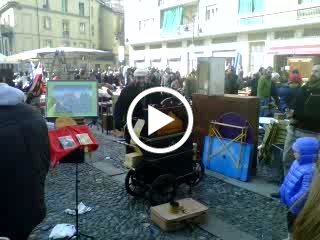
The flea Market in Turin, on a Sunday 

Il mercato delle Pulci a Torino, una Domenica 


Tuesday, 7 April 2015

Visita- Orientalism in Turin

Bazar in Konstantinople
Far off Eastern countries did not only attract archeologists and collectors but also visual artists. An example is Alberto Pasini (1826 – 1899) who, after attending schools of arts and after a period spent in Turin for his studies, was attracted by Orientalism, a romantic movement which was born after the Napoleonic expedition to Egypt and that increased with the expansion of European colonialism. In 1855 started his long journey with a French diplomatic mission through Turkey, Persia, Araby and Egypt. During this long trip he drew about 60 studies and many sketches which became paintings back in France and then in Italy.   


http://foglidarte.blogspot.it/2014/06/alberto-pasini-un-pittore-ottocentesco.html

Go to our Catalogue for Ebooks and Stories


Versione Italiana

Interior of a Mosque in Cordova
La curiosità verso terre lontane non spinse solo archeologi e collezionisti a viaggiare in oriente, ma anche artisti. Un esempio è il pittore parmense  Alberto Pasini (Busseto 3 settembre 1826 – Cavoretto , 15 dicembre 1899) che, dopo aver frequentato alcune scuole d'arte e avere soggiornato a Torino per studi, fu affascinato dal movimento Orientalista – nato nel 19° secolo in seguito alla spedizione di Napoleone in Egitto e all'espansione coloniale europea. Pasini intraprese un viaggio al seguito di una spedizione diplomatica francese verso Egitto, Turchia, Persia e Arabia nel 1855. Durante questo periodo eseguì circa sessanta disegni e molti schizzi che diventarono poi pitture quando ritornò in Europa, in Francia e poi in Italia.
http://foglidarte.blogspot.it/2014/06/alberto-pasini-un-pittore-ottocentesco.html

Tuesday, 31 March 2015

Visita- The detective of Mysteries in Turin

Per la Versione Italiana
The history of Turin's origin is so intriguing that also the famous archeologist Martin Mystere and his friends try to understand the secrets hidden in the esoteric town. Positive and evil forces will fight in the attempt to  understand the meaning of hermetic letters, to follow clues collected from witnesses and during surveys in vaults and caves leading to  hell. What is the link between Turin and the Egyptian Pyramids, explored only by bold archeologists and unscrupulous figures? In the centre of this mystery is a church: the Gran Mother.  The title of the adventure? Nea
Heliopolis

http://bonellieditore.fumetto-online.it/bonelli-editore-martin-mystere-133-nea-heliopolis-
c17740001330.php
http://www.comicvine.com/martin-mystere-133-nea-heliopolis/4000-279898/

Go to our Catalogue for Ebooks and Stories


Versione Italiana
La storia delle origini di Torino è talmente misteriosa da attirare anche Martin Mystere e i suoi accoliti per scoprire cosa si nasconde nella città esoterica per eccellenze. In Nea Heliopolis forze malvagie ed energie positive si combattono, cercando di svelare i segreti nascosti in ermetiche lettere, di carpire indizi sulle origini di Torino, indizi raccolti da testimoni e durante sopralluoghi in  grotte e sotterranei che aprono le porte degli inferi. Tutto questo e altro ancora uniscono la capitale piemontese alle piramidi che sorgono nel grande deserto egiziano con i  loro cunicoli esplorati solo da archeologi senza paura e da personaggi senza scrupoli. Eppure anche questo è Torino. Il centro di questo ennesimo mistero? Una chiesa, la Gran Madre.

http://bonellieditore.fumetto-online.it/bonelli-editore-martin-mystere-133-nea-heliopolis-
c17740001330.php
http://www.comicvine.com/martin-mystere-133-nea-heliopolis/4000-279898/

Go to our Catalogue for Ebooks and Stories

Tuesday, 24 March 2015

Visita- Il sogno verticale

Per la Versione Italiana
Mole Antonelliana 
Mole Antonelliana:  “a vertical dream.”
The Mole Antonelliana, Turin's landmark, is 167.5 meters in height - the tallest structure in all of Europe once. Begun  in 1863 by the architect Alessandro Antonelli from Novara,  the building was originally meant to be a synagogue but the Municipality of Torino bought it in 1878, under construction, and turned it  into a monument to national unity. The building was completed in 1889, not by Antonelli (who died the year before at the age of ninety and worked until his end) but by his son Costanzo.   In 1961, on the occasion of the celebrations for the 100th anniversary of the Unity of Italy, a panoramic lift was installed. Renovated in 1999 the lift  now takes visitors up to the “small temple” and the extraordinary 360° view from its balcony over the city.  There are no intermediate floors between the lift’s departure point at the 10 meter level and its arrival point, 85 meters higher up.

http://blog.turismotorino.org/utilities/ascensore-mole-antonelliana/
http://silvanadicristofano.blogspot.it/2014/07/la-mole-antonelliana-torino.html

Go to our Catalogue for Ebooks and Stories


 Versione Italiana
Mole Antonelliana. sezione
La Mole Antonelliana, simbolo di Torino, è alta 167,5 metri, e un tempo era considerata la più alta struttura in Europa. Iniziata nel 1863 dall'architetto Alessandro Antonelli di Novara, l'edificio originariamente avrebbe dovuto ospitare la sinagoga, ma il comune la comprò non ancora ultimata e la destinò ad essere monumento per l'Unità d'Italia. L'edificio fu completato nel 1889, non da Antonelli (che morì l'anno precedente novantenne e che lavorò fino alla fine) ma dal figlio COstanzo. Mel 1961, in occasione delle celebrazioni per il 100° anniversario dell'unità d'Italia, venne installato un ascensore panoramico. Rinnovato nel 1999 l'ascensore ora porta i visitatori al tempietto da dove possono godere di una vista straordinaria a 360° sulla città. Non ci sono piani intermedi tra il piano terra  a 10 metri di altezza e la cima, 85 metri più in alto.


http://blog.turismotorino.org/utilities/ascensore-mole-antonelliana/
http://silvanadicristofano.blogspot.it/2014/07/la-mole-antonelliana-torino.html

Go to our Catalogue for Ebooks and Stories

Saturday, 21 March 2015

Visita - Erasmo da Rotterdam in Torino

Erasmo da Rotterdam


From 1506 to 1509  Erasmo da Rotterdam, was in Italy: in 1506 he graduated as Doctor of Divinity at the Turin University. He took the degree in Divinity because Psychology did not yet exist, but both subjects are related to the search into the soul.
Desiderius Erasmus Roterodamus was born on 27 October 1466  and died on 12 July 1536. He was a Dutch Renaissance humanist, Catholic priest, social critic, teacher, and theologian. Orphaned at an early age, he travelled a lot before coming to Turin. For this reason the project Erasmus is an acronym inspired to his name  - European Region Action Scheme for the Mobility of University Students – to stress the importance of knowing other culture different from the native one.


Go to our Catalogue for Ebooks and Stories


Targa a Torino 

Anche Erasmo da Rotterdam venne a Torino, città, dove si laureò il 4 settembre del 1506. Testimone di questo storico evento è una targa. Si laureò in teologia quando ancora una facoltà di psicologia non esisteva, ma sia la teologia sia la psicologia condividono quella che vien definita “ricerca attorno all’anima”. E’ noto che il grande pensatore, nato a Rotterdam, rimasto orfano in giovane età, viaggiò moltissimo e prima di arrivare a Torino trascorse del tempo a Parigi per arricchire la propria cultura. Dunque, il progetto universitario Erasmus prende il nome proprio da Lui, è un acronimo -  European Region Action Scheme for the Mobility of University Students -  per affermare quanto sia importate oggi, come allora, affacciarsi a culture diverse dalla propria.


http://www.mole24.it/2014/09/04/erasmo-rotterdam-torino-per-laurearsi/


Go to our Catalogue for Ebooks and Stories

Tuesday, 17 March 2015

Visita- the temple of the cinema

 Per la Versione Italiana
The MOLOCH 
The  Mole Antonelliana also hosts  The National Cinema Museum  which  is unique in the world  as it offers objects which made  the history of photography, artifacts of the  pre-cinema era and  a panoramic view of the technical, scientific and artistic paths that led to the birth of cinema together with different scientific and educational activities. The idea for the National Cinema Museum was conceived in 1941 when Maria Adriana Prolo planned the creation of a space totally dedicated to the documentation of Torino’s film industry. First opened in Palazzo Chiablese, a wing of the Royal Palace, was closed in 1985 for safety reasons,  and riopened in 2000 inside the Mole Antonelliana, The  Swiss set designer François Confino who has arranged the various halls said that the  museum  is  “[...] a temple of cinema in a place of exceptional architectural caliber, a conspiratorial and inviting tribute to the Mole Antonelliana." 
http://museonazionalecinema.blogspot.it/
Museum of the Cinema - inside
La Mole Antonelliana ospita anche il Museo del Cinema,  unico al
mondo in quanto espone gli oggetti che fecero la storia della fotografia, dall'era pre-cinematgrafica e una panoramica di tutti gli sviluppi tecnici ed artistici ed offre attività di tipo scientifico ed educativo. L'idea del Museo venne a Maria Adriana Prolo quando, nel 1941, pensò di realizzare uno spazio dedicato alla documentazione dell'industrai cinematografica di Torino. Dapprima a Palazzo Chiablese, ala  di Palazzo Reale, poi chiuso per moticvi di sicurezza nel 1985,  fu riaperto nel 2000 all'interno delle Mole. Il designer svizzerò François Confino che ne ha progettato le sale l'ha definito "[...] un tempio del cinema all'interno di un luogo di eccezionale elevatura architettonica, un autentico tributo alla Mole Antonelliana"

Go to our Catalogue for Ebooks and Stories