Showing posts with label diCarta. Show all posts

Sunday, 13 September 2015

visita - Giuseppe Culicchia


Giuseppe Culicchia (Turin, 1965) has always liked writing and started creating stories at Palazzo Nuovo, Turin University. He worked as assistant librarian in London and, back in Turin, in book shops. In 1994, his first best seller Tutti giù per Terra was published and then  adapted for the cinema by Davide Ferrario, starring Valerio Mastandrea (1997). He loves translating American classics like Mark Twain and Francis Scott Fitzgerald.
Other works? Paso Doble , Bla Bla Bla, Ambarabà , A spasso con Anselmo, Liberi tutti, quasi, Il paese delle meraviglie, Un”estate al mare , Torino è casa mia , Ecce Toro, Ritorno a Torino dei Signori Tornio (for the stage), Sicilia, o cara. Un viaggio sentimentale,  Brucia la città,  Ameni Inganni and Venere in Metrò. 


www.giuseppeculicchia.it/biografia/

Go to our Catalogue for Ebooks and Stories


Giuseppe Culicchia (Torino 1965) ha sempre amato scrivere. Già all'università creava storie e ha continuato a scrivere durante il periodo trascorso a Londra come assistente bibliotecario e poi di nuovo a Torino come magazziniere o commesso in vari negozi di libri. Il suo primo best seller è stato pubblicato  nel 1994  Tutti giù per Terra, adattato per il cinema nel 1997 dal regista Davide Ferrario con Valerio Mastandrea nel cast. Ama tradurre i classici americani come Mark Twain e Francis Scott Fitzgerald.
Altri libri? Paso Doble, Bla Bla Bla, Ambarabà, A spasso con Anselmo, Liberi tutti, quasi, Il paese delle meraviglie, Un'estate al mare, Torino è casa mia, Ecce Toro, Ritorno a Torino dei Signori Tornio (per il teatro), Sicilia, o cara. Un viaggio sentimentale,  Brucia la città, Ameni Inganni e Venere in Metrò. 
,

Sunday, 6 September 2015

visita: Torino è casa mia

http://youtu.be/6rX5GLNXsU8


Trailer of  Giuseppe Culicchia's book Torino è casa mia created by  Andrea Iadarola and  Filippo, Favaro, students from Liceo Scientifico A. Gramsci, Ivrea. It was presented at the second edition of L'Antonello, award for the best book trailer at the Salone del Libro in Turin.


http://youtu.be/6rX5GLNXsU8


Trailer del libro di Giuseppe Culicchia Torino è Casa Mia realizzato dagli studenti del Liceo Gramsci di Ivrea Andrea Iadarola e Filippo Favaro e presentato alla seconda edizione del premio L'Antonello per il miglior booktrailer al Salone del Libro di Torino.

Wednesday, 2 September 2015

visita: the Archaeological Museum in Turin


The Archaeological Museum of Turin dates back to the 16th century thanks to Emanulele Filiberto’s collections. The seat has changed during the centuries and  the works of art have increased. In 1940 the collections were moved to the Greenhouses of Palazzo Reale where they are nowadays, However, a new location is going to be set up in the subterranean of the New Wing of Palazzo Reale.


Go to our Catalogue for Ebooks and Stories


http://museoarcheologico.piemonte.beniculturali.it/


Il museo risale alla metà del 1500 grazie alle raccolte di Emanuele Filiberto di Savoia. La sede delle collezioni e il numero delle opere sono variati nel corso dei secoli, Nel 1940, con la definitiva separazione dal Museo Egizio, nasce il nuovo Museo di Antichità, ora  nelle Serre di palazzo Reale,  ma prossimamente verranno allestite delle sale nel piano sotterraneo della Manica Nuova di Palazzo Reale.


Go to our Catalogue for Ebooks and Stories


Saturday, 29 August 2015

visita - Palazzo Chiablese

Palazzo Chiablese 


The Palazzo Chiablese is a wing of the Royal Palace in Piazza San Giovanni, Turin.
It was named after the Duke of Chablais, second son of King Carlo Emanuele III. During his reign various improvements to the interior of the palace (1753- 54) were carried out under the direction of Benedetto Alfieri, a popular Savoyard architect of the era.
The building was the seat of the provisional government of France during the Napoleonic occupation and it  was the home of Camillo Borghese and his wife Pauline Bonaparte.
Later it  saw the birth of Margherita of Savoy, daughter of the Duke of Genoa and later first Queen of Italy (wife of King Umberto I).
Bombed during World War II, the  property passed to the State in the 1950s and it was then used as the Superintendence headquarters. Then it housed the pupils of the Istituto Nazionale per le Figlie dei Militari Italiani (National Institute for Italian Soldiers' Daughters). Until 1995 it was home to the city's cinema archive now it is a museum and a place for concerts and exhibitions.


http://www.poloreale.beniculturali.it/index.php/it/il-complesso/palazzo-chiablese


Go to our Catalogue for Ebooks and Stories


Interior


Palazzo Chiablese  si trova a sinistra del Palazzo Reale, con l'entrata principale in Piazza S. Giovanni.
Risale  al XVI secolo, fatto costruire dal duca di Savoia Emanuele Filiberto su nuclei abitativi preesistenti, l’ architetto Benedetto Alfieri nel 1753-54 diede unità architettonica al palazzo per ordine di Carlo Emanuele III che lo donò al secondogenito Benedetto Maurizio, Duca del Chiablese da cui prese il nome. Durante il periodo di occupazione francese di Torino fu abitato da Camillo Borghese e sua moglie Paolina. Con la Restaurazione, divenne residenza del re Carlo Felice,  di Ferdinando duca di Genova, secondogenito di Carlo Alberto,  e nel 1851 vi nacque Margherita, prima regina d’Italia (moglie di Re Umberto I) dal 1878 al 1900.
Bombardato durante la seconda guerra mondiale, passo poi al Demanio (1946), è stato dapprima sede dell'Archivio del Cinema  ed ora ospita la Direzione Regionale per i Beni Culturali e Paesaggistici del Piemonte ed è sede di  mostre d’arte.


Go to our Catalogue for Ebooks and Stories

Sunday, 23 August 2015

visita- Palazzo Reale a Torino

 The Royal Palace of Turin was the centre of the House of Savoy's political affairs for three centuries. Built in the 16th century, was later modernized by the Baroque architect Filippo Juvarra under Christine Marie of France (1606–63). The palace also includes the Palazzo Chiablese and the Chapel of the Holy Shroud. In 1946 it was made into a museum and has been one of the thirteen residence of the House of Savoy on the UNESCO World Heritage Site list since 1997.


http://www.ilpalazzorealeditorino.it/
http://www.ilpalazzorealeditorino.it/Eventi/Eventi-del-Palazzo%20Reale%20di%20Torino.asp?Sez=3&id=84&read=1&disp=1&id_a=84
http://www.comune.torino.it/musei/elenco/reale.shtml


Il Palazzo reale di Torino fu il centro della politica della Casa Savoia per tre secoli. Costruito nel 1500 fu poi modernizzato
dall’ architetto Filippo Juvarra durante il periodo di Cristina Maria di Francia (1606-63) nel secolo 17°. 
Il palazzo include Palazzo Chiablese e la Cappella della Santa Sindone. Nel 1946 divenne un museo ed è parte del Patrimonio dell’Umanità dell’UNESCO dal 1997 insieme con altri 13 palazzi della Casa Savoia.


Go to our Catalogue for Ebooks and Stories

Wednesday, 19 August 2015

visita- Enrica Pagella and the Polo Reale in Turin


A very important news: Enrica Pagella was appointed yesterday director of the Polo Museale in Turin. Enrica Pagella was born in Ivrea. After a degree  in Art History at Turin  University and a master in Artistic and Environmental Heritage at Milan University, has been  the director of Palazzo Madama and Borgo Medievale in Turin since 2003. Before, from 1988 to 1999 directed the Art Museum in Modena. She has taught in various universities and has published remarkable books included Van Eyck, Antonello Leonardo. Tre capolavori del Rinascimento and two volumes about art in Piedmont.
The Polo Reale in Turin include the main museums and palaces in the city: Palazzo Reale, l'Armeria Reale, la nuova Galleria Sabauda, il Museo Archeologico and  Palazzo Chiablese.  

http://www.lastampa.it/2015/08/18/cronaca/enrica-pagella-nuovo-direttore-polo-reale-MLPhtHeb3l2t37VbTyV09I/pagina.html

http://torino.repubblica.it/cronaca/2015/08/18/news/beni_culturali_enrica_pagella_nuovo_direttore_del_polo_reale-121167791/


C'è una grossa novità a Torino: Enrica Pagella sarà il nuovo direttore del Polo Reale di Torino. Nata a Ivrea, si è laureata in Storia dell'Arte all'Università di Torino, studi poi approfonditi con un dottorato di ricerca a Milano su Beni Culturale ed Ambientali. Dal 1988 al 1999 è stata direttrice del Museo d'Arte di Modena e dal 2003 dirige Palazzo Madama e il Borgo Medievale di Torino. Ha insegnato in varie università e ha scritto molte importanti pubblicazioni tra cui  Van Eyck, Antonello Leonardo. Tre capolavori del Rinascimento e due volumi sull'arte in piemonte.
Il Polo Reale di Torino riunisce i palazzi e i musei più importanti di torino: Palazzo reale, l'Armeria Reale, la nuova Galleria Sabauda, il Museo Archeologico e Palazzo Chiablese.  

Wednesday, 12 August 2015

visita - the museum of oriental art


The  Museo d'Arte Orientale  (MAO) -  The Museum of Oriental Art – is one of the main Asian collections in Italy. Located in Palazzo Mazzonis in Turin (a cross street of Via Garibaldi), it was opened on December 5, 2008.
After two Japanese rock gardens at the entrance, the three floors of the museum house collections from Gandhara, India and Southeast Asia, from  China, from Buddhist and Tibetan culture, from Islamic countries like Turkey, Iran, Iraq , from  the Arabian Peninsula and  statues, paintings, lacquers from.


http://www.maotorino.it/
https://www.facebook.com/pages/MAO-Museo-dArte-Orientale/34503163094
http://www.comune.torino.it/musei/elenco/mao.shtml


 foto del giardino giapponese all'entrata 

Il museo di arte orientale di Torino è situato a Palazzo Mazzonis ed è stato aperto il 5 dicembre 2008. E' uno dei maggiori musei di arte orientale in Italia e, nei suoi tre piani di esposizione, mostra  reperti provenienti da tutta l'Asia - dall'India, dal sud-est asiatico, Cina, Tibet, Turchia, Iran , Iraq, Penisola Arabica e dal Giappone.  All'entrata si possono ammirare i giardini rocciosi giapponesi. 

Sunday, 5 July 2015

visita: San Lorenzo

San Lorenzo - the dome 

San Lorenzo was the first church which hosted the Sacra Sindone (Holy Shroud)  in Turin when Duke Emanuele Filiberto took it from Chambery  in 1578.  San Lorenzo was built by abbot Guarino Guarini and then restored by Emanuele Filiberto who named it San Lorenzo because of a vow made during a battle won in Fiandre on the 10th August. The church is in Piazza Castello near Palazzo Madama and Palazzo Real. Inside there are numerous precious works of art and interesting stimuli for people who love mystery. The architect seems to have hidden  messages  in the forms, in the colours and in the numbers which decorate the building, symbols that accompany men to reach the Absolute. Angels look at the visitor together with menacing and devilish faces as to show that good can't exist without evil as light can't exist without darkness. On the spring and Autumn equinoxes a ray enters  from the dome and strikes the porthole of the first chapel near the altar showing  a fresco of God which otherwise would be invisible in the darkness.

http://eng.sanlorenzo.torino.it/
http://www.visitatorino.com/en/church_of_san_lorenzo.htm

Go to our Catalogue for Ebooks and Stories


San Lorenzo - esterno 

La Real Chiesa di S.Lorenzo a Torino fu la  prima chiesa che ospitò la Sindone quando  il duca Emanuele Filiberto di Savoia la fece portare nel 1578 dal castello di Chambery, dove si trovava dal 1453. La chiesa fu costruita  dall'abate teatino Guarino Guarini, e  fu poi restaurata grazie all'interesse del duca Emanuele Filiberto che la intitolò  a San Lorenzo, per un  voto  fatto nelle Fiandre durante una battaglia vinta il 10 agosto 1557. Situata in Piazza Castello, vicino a Palazzo Reale e a Palazzo Madama la chiesa è chiusa tra edifici  e non dà l'idea di essere un luogo di culto, ma all'interno offre opere d'arte di un certo pregio e stimoli interessanti, per gli amanti del mistero. Il progettista sembra che abbia volutamente creato  un complesso insieme di contrasti apparenti, di messaggi insiti nelle forme, nei colori, nei numeri, per un percorso verso 'Assoluto :  centinaia di figure angeliche (oltre 400) guardano da affreschi e  sculture, mentre sulla cupola ci sono volti minacciosi e diabolici.  Forse l'architetto volle   indicare che non c'è luce senza tenebra, non c' è bene senza male. Inoltre durante  il giorno dell'Equinozio di Primavera e d'Autunno, avviene un fenomeno sorprendente:  il raggio che entra a mezzogiorno dalla cupola va a colpire l'oblò della prima cappella accanto all'altare e  illumina un affresco di Dio Padre che altrimenti sarebbe completamente buio e invisibile!

http://www.tripadvisor.it/Attraction_Review-g187855-d595928-Reviews-Real_Chiesa_di_San_Lorenzo-Turin_Province_of_Turin_Piedmont.html

Go to our Catalogue for Ebooks and Stories


Sunday, 28 June 2015

visita: Nietzsche in Turin

In Turin, at 6, Via Carlo Alberto, on the corner of the square,  Friederich Nietzsche lived for a brief period, from 5th April to 5 June 1888 and the first months of the following year. It was in Turin that  the German philosppher wrote Ecce homo. He loved the city and  descibed it as  severe and elegant. The philosopher  wrote to his friend Peter Gast that he could work, eat and sleep in Turin ...the air gave him energy. Unfortunately it was just in the piedmontese capital  that Nietzsche showed the first signs of his insanity: when he saw a coachman beating his horse, he insulted him and embraced and kissed the animal. While  taken home Nietzsche cried and shouted he was God; afterwards his friend Overbeckper accompanied him to Basilea to be cured.


In via Carlo Alberto numero 6, all'angolo con l'omonima piazza, abitò per un breve periodo - dal 5 aprile al 5 giugno 1888 e per i primi mesi dell'anno successivo  - Friedrich Wilhelm Nietzsche e qui il filosofo scrisse il libro della sua vita, Ecce homo. Nietzsche era letteralmente innamorato dell'atmosfera torinese, dignitosa, severa , elegante. In una lettera all'amico Peter Gast si legge che qui si sentiva di buon umore “Mangio come un dio, riesco a dormire nonostante il rumore delle carrozze che passano di notte.” Purtroppo sempre a Torino si mostrarono i primi  segni della sua follia. Il 3 gennaio del 1889, nel centro di Torino, Nietzsche, uscendo di casa, vide un cocchiere frustare a prendere a calci il suo cavallo. "Tu, disumano massacratore di questo destriero!", inveì il filosofo furibondo abbracciando e baciando sconvolto il cavallo. Fu accompagnato a casa e quindi portato via dalla città dall'amico Overbeck per essere curato a Basilea. 


Go to our Catalogue for Ebooks and Stories


Wednesday, 17 June 2015

visita: Kha and Merit's tomb (Egyptian Museum)

In the Egyptian Musium.
Merit and Kha were buried with the objects they loved when alive and necessary  in their afterlife.  Unguents and kohl were essential for cleanliness and were preserved in vases with a cover made of alabaster, glass and ceramic. Kohl was used as a protection against sun and flies: they spread it under the eyes as a make up. It was kept in a palm shaped vase as the palms were symbols of life. The glass was very precious as it was quite new. All these little vessels were put inside a two level box  with five compartments. The box is decorated with a chess pattern and a lotus gem – the lotus means rebirth as it is a flower which closes at night and disappears in the water to re – emerge the following day. The sentence written on the box says that it is an offer to Merit's spirit.

http://collezioni.museoegizio.it/eMuseumPlus?service=ExternalInterface&module=collection&objectId=102290&viewType=detailView
https://www.facebook.com/media/set/?set=a.405210236199413.101049.178778378842601&type=3


Go to our Catalogue for Ebooks and Stories


Al Museo Egizio.
La tomba di Kha e di Merit era corredata di tutti gli oggetti da loro usati in vita, necessari nell’Aldilà. Gli unguenti e il kohl erano considerati elementi essenziali per l’igiene e venivano conservati in una varietà di recipienti con coperchio in alabastro, vetro e ceramica. Gli Egizi si proteggevano dal sole e dalle mosche spalmandosi sotto gli occhi del kohl scuro. Il tipico recipiente per il kohl era a forma di palma, simbolo della vita.  Il vetro era un materiale relativamente nuovo e perciò considerato prezioso. Tutti questi recipienti di forme diverse, furono sistemati con cura in questa cassetta di legno a due livelli, dotata sul fondo di cinque scompartimenti. Il cofanetto è decorato con un motivo a scacchiera e con una gemma di loto e una bordura di questi fiori (il loto simboleggia la rinascita perché di notte si chiude e va a fondo, per rifiorire però all’alba). L’iscrizione, forse aggiunta poco prima della sepoltura, riporta che il cofanetto è un’offerta funeraria per lo spirito di Merit.


Go to our Catalogue for Ebooks and Stories


Sunday, 14 June 2015

visita: Modern Art Gallery (GAM)

 The collection of Modern Art was founded in 1863 and  hosted in a building near  Mole Antonelliana. From 1895 to 1942 it was exhibited in a pavilion in Corso Siccardi (now Corso Galileo Ferraris) unfortunately destroyed during World War 2. In 1959 a building was erected planned by Carlo Bassi and Goffredo Boschetti. Closed in 1980s and restored, it was re-opened in 1993. In 2013 the whole collection – about over 47,000 art works - was re-organized according to four themes: Infinite, Speed, Ethic and Nature.


 http://www.contemporarytorinopiemonte.it/ita/Luoghi/GAM-Galleria-Civica-D-Arte-Moderna-e-Contemporanea
http://www.torinoblog.com/?p=1279


Go to our Catalogue for Ebooks and Stories


La collezione di Arte Moderna ebbe inizio  nel 1863, in un edificio presso la Mole Antonelliana.
Dal 1895 al 1942 fu esposta in un padiglione in Corso Siccardi (ora Corso Galileo Ferraris) distrutto durante i bombardamenti della II Guerra Mondiale. Nello stesso luogo, iniziò la costruzione dell'edificio progettato da Carlo Bassi e Goffredo Boschetti che venne inaugurato nel 1959. Negli anni Ottanta il palazzo fu dichiarato inagibile e riaprì dopo una lunga serie di restauri nel luglio1993. Nel  2013 sono stati istituiti i percorsi Infinito, Velocità, Etica e Natura. Il patrimonio della galleria si compone di oltre 47.000 opere tra dipinti, sculture, installazioni e video.


Go to our Catalogue for Ebooks and Stories


Sunday, 7 June 2015

visita: Mickey mouse in Turin

Mickey Mouse visited Turin to celebrate the 150th anniversary of the Italian Unity, but the  most famous story set in Turin of  the popular Disney hero  is the one related to an adventure at the Egyptian Museum. Mickey - together with Goofy,  Minnie and the director of Mousetown  museum, Mr Zapotec - must take an important Indian relic to the Egyptian Museum in Turin.  The populat group visits  the city with its museums  (“How many museum this city has!” Goofy says), taste the delicious chocolate …..till the find is stolen and the adventure starts . Of course with the usual happy ending.
The story was written by Gianfranco Goria and designed by Giampiero Ubezio for the 7th February 1993 issue – when the little magazine still cost 2.300 liras.


Go to our Catalogue for Ebooks and Stories


Topolino visitò Torino più volte, una per celebrare i 150 anni dell'unità d'Italia, ma la storia più famosa è quella ambientata al Museo Egizio. L'avventura si apre su un aereo in volo verso Torino. A bordo il professor Zapotec, direttore del museo di Topolinia, accompagnato da Pippo, Topolino e Minni. Il gruppo  deve portare alcuni importanti reperti al Museo Egizio, ma arrivati a torino i nostri amicic fanno i turisti, e pregustani  i gianduiotti e la pasticceria torinese. La  sera prima dell'inaugurazione, però, la statuetta viene rubata. Qui comincia il giallo che porterà alla scoperta del ladro. La storia fu scritta da Gianfranco Goria e disegnata da Giampiero Ubezio per il numero del 7 febbraio 1993, quando il giornalino costava ancora 2.300 lire. 


Go to our Catalogue for Ebooks and Stories

Saturday, 2 May 2015

visita: il Balon

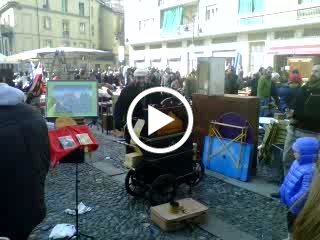
The flea Market in Turin, on a Sunday 

Il mercato delle Pulci a Torino, una Domenica 


Tuesday, 31 March 2015

Visita- The detective of Mysteries in Turin

Per la Versione Italiana
The history of Turin's origin is so intriguing that also the famous archeologist Martin Mystere and his friends try to understand the secrets hidden in the esoteric town. Positive and evil forces will fight in the attempt to  understand the meaning of hermetic letters, to follow clues collected from witnesses and during surveys in vaults and caves leading to  hell. What is the link between Turin and the Egyptian Pyramids, explored only by bold archeologists and unscrupulous figures? In the centre of this mystery is a church: the Gran Mother.  The title of the adventure? Nea
Heliopolis

http://bonellieditore.fumetto-online.it/bonelli-editore-martin-mystere-133-nea-heliopolis-
c17740001330.php
http://www.comicvine.com/martin-mystere-133-nea-heliopolis/4000-279898/

Go to our Catalogue for Ebooks and Stories


Versione Italiana
La storia delle origini di Torino è talmente misteriosa da attirare anche Martin Mystere e i suoi accoliti per scoprire cosa si nasconde nella città esoterica per eccellenze. In Nea Heliopolis forze malvagie ed energie positive si combattono, cercando di svelare i segreti nascosti in ermetiche lettere, di carpire indizi sulle origini di Torino, indizi raccolti da testimoni e durante sopralluoghi in  grotte e sotterranei che aprono le porte degli inferi. Tutto questo e altro ancora uniscono la capitale piemontese alle piramidi che sorgono nel grande deserto egiziano con i  loro cunicoli esplorati solo da archeologi senza paura e da personaggi senza scrupoli. Eppure anche questo è Torino. Il centro di questo ennesimo mistero? Una chiesa, la Gran Madre.

http://bonellieditore.fumetto-online.it/bonelli-editore-martin-mystere-133-nea-heliopolis-
c17740001330.php
http://www.comicvine.com/martin-mystere-133-nea-heliopolis/4000-279898/

Go to our Catalogue for Ebooks and Stories

Tuesday, 24 March 2015

Visita- Il sogno verticale

Per la Versione Italiana
Mole Antonelliana 
Mole Antonelliana:  “a vertical dream.”
The Mole Antonelliana, Turin's landmark, is 167.5 meters in height - the tallest structure in all of Europe once. Begun  in 1863 by the architect Alessandro Antonelli from Novara,  the building was originally meant to be a synagogue but the Municipality of Torino bought it in 1878, under construction, and turned it  into a monument to national unity. The building was completed in 1889, not by Antonelli (who died the year before at the age of ninety and worked until his end) but by his son Costanzo.   In 1961, on the occasion of the celebrations for the 100th anniversary of the Unity of Italy, a panoramic lift was installed. Renovated in 1999 the lift  now takes visitors up to the “small temple” and the extraordinary 360° view from its balcony over the city.  There are no intermediate floors between the lift’s departure point at the 10 meter level and its arrival point, 85 meters higher up.

http://blog.turismotorino.org/utilities/ascensore-mole-antonelliana/
http://silvanadicristofano.blogspot.it/2014/07/la-mole-antonelliana-torino.html

Go to our Catalogue for Ebooks and Stories


 Versione Italiana
Mole Antonelliana. sezione
La Mole Antonelliana, simbolo di Torino, è alta 167,5 metri, e un tempo era considerata la più alta struttura in Europa. Iniziata nel 1863 dall'architetto Alessandro Antonelli di Novara, l'edificio originariamente avrebbe dovuto ospitare la sinagoga, ma il comune la comprò non ancora ultimata e la destinò ad essere monumento per l'Unità d'Italia. L'edificio fu completato nel 1889, non da Antonelli (che morì l'anno precedente novantenne e che lavorò fino alla fine) ma dal figlio COstanzo. Mel 1961, in occasione delle celebrazioni per il 100° anniversario dell'unità d'Italia, venne installato un ascensore panoramico. Rinnovato nel 1999 l'ascensore ora porta i visitatori al tempietto da dove possono godere di una vista straordinaria a 360° sulla città. Non ci sono piani intermedi tra il piano terra  a 10 metri di altezza e la cima, 85 metri più in alto.


http://blog.turismotorino.org/utilities/ascensore-mole-antonelliana/
http://silvanadicristofano.blogspot.it/2014/07/la-mole-antonelliana-torino.html

Go to our Catalogue for Ebooks and Stories

Saturday, 21 March 2015

Visita - Erasmo da Rotterdam in Torino

Erasmo da Rotterdam


From 1506 to 1509  Erasmo da Rotterdam, was in Italy: in 1506 he graduated as Doctor of Divinity at the Turin University. He took the degree in Divinity because Psychology did not yet exist, but both subjects are related to the search into the soul.
Desiderius Erasmus Roterodamus was born on 27 October 1466  and died on 12 July 1536. He was a Dutch Renaissance humanist, Catholic priest, social critic, teacher, and theologian. Orphaned at an early age, he travelled a lot before coming to Turin. For this reason the project Erasmus is an acronym inspired to his name  - European Region Action Scheme for the Mobility of University Students – to stress the importance of knowing other culture different from the native one.


Go to our Catalogue for Ebooks and Stories


Targa a Torino 

Anche Erasmo da Rotterdam venne a Torino, città, dove si laureò il 4 settembre del 1506. Testimone di questo storico evento è una targa. Si laureò in teologia quando ancora una facoltà di psicologia non esisteva, ma sia la teologia sia la psicologia condividono quella che vien definita “ricerca attorno all’anima”. E’ noto che il grande pensatore, nato a Rotterdam, rimasto orfano in giovane età, viaggiò moltissimo e prima di arrivare a Torino trascorse del tempo a Parigi per arricchire la propria cultura. Dunque, il progetto universitario Erasmus prende il nome proprio da Lui, è un acronimo -  European Region Action Scheme for the Mobility of University Students -  per affermare quanto sia importate oggi, come allora, affacciarsi a culture diverse dalla propria.


http://www.mole24.it/2014/09/04/erasmo-rotterdam-torino-per-laurearsi/


Go to our Catalogue for Ebooks and Stories

Tuesday, 17 March 2015

Visita- the temple of the cinema

 Per la Versione Italiana
The MOLOCH 
The  Mole Antonelliana also hosts  The National Cinema Museum  which  is unique in the world  as it offers objects which made  the history of photography, artifacts of the  pre-cinema era and  a panoramic view of the technical, scientific and artistic paths that led to the birth of cinema together with different scientific and educational activities. The idea for the National Cinema Museum was conceived in 1941 when Maria Adriana Prolo planned the creation of a space totally dedicated to the documentation of Torino’s film industry. First opened in Palazzo Chiablese, a wing of the Royal Palace, was closed in 1985 for safety reasons,  and riopened in 2000 inside the Mole Antonelliana, The  Swiss set designer François Confino who has arranged the various halls said that the  museum  is  “[...] a temple of cinema in a place of exceptional architectural caliber, a conspiratorial and inviting tribute to the Mole Antonelliana." 
http://museonazionalecinema.blogspot.it/
Museum of the Cinema - inside
La Mole Antonelliana ospita anche il Museo del Cinema,  unico al
mondo in quanto espone gli oggetti che fecero la storia della fotografia, dall'era pre-cinematgrafica e una panoramica di tutti gli sviluppi tecnici ed artistici ed offre attività di tipo scientifico ed educativo. L'idea del Museo venne a Maria Adriana Prolo quando, nel 1941, pensò di realizzare uno spazio dedicato alla documentazione dell'industrai cinematografica di Torino. Dapprima a Palazzo Chiablese, ala  di Palazzo Reale, poi chiuso per moticvi di sicurezza nel 1985,  fu riaperto nel 2000 all'interno delle Mole. Il designer svizzerò François Confino che ne ha progettato le sale l'ha definito "[...] un tempio del cinema all'interno di un luogo di eccezionale elevatura architettonica, un autentico tributo alla Mole Antonelliana"

Go to our Catalogue for Ebooks and Stories


Tuesday, 10 March 2015

Visita- La Madama del Palazzo

Per la Versione Italiana
Maria Giovanna Battista
Who is the lady to whom Palazzo Madama in Turin is entitled’ She is Maria Giovanna Battista. Born in Paris, she moves to Turin at 21 years old , in 1665, following her husband the Duke Carlo Emanuele II from Savoia. In 1675 her husband dies leaving her with a nine year-old boy. She becomes the Ruling Queen and takes particular care to the development of cultural activities. When  her son comes of age,  she moves from Palazzo Reale to the Palace now named after her Palazzo Madama  and  asks architect Juvarra to build the marvellous staircase (1714).

http://www.palazzomadamatorino.it/news.php?id_news=355


Go to our Catalogue for Ebooks and Stories


Versione Italiana
Maria Giovanna Battista
Chi è la madama a cui il Palazzo al centro di Torino è intitolata?
Si tratta di Maria Giovanna Battista, nata a Parigi, ma trasferitasi a Torino nel 1665, a ventun’anni, in seguito al matrimonio con il duca Carlo Emanuele II di Savoia. Nel 1675, rimane vedova con un figlio, Vittorio Amedeo II, di soli nove anni. Deve quindi assumere la reggenza dello Stato, e lo fa ponendo particolare attenzione allo sviluppo della cultura durante tutto il periodo del suo governo. Al compimento della maggiore età del figlio e al passaggio del potere nelle sue mani, la duchessa trasferisce la propria residenza e la sua corte nel castello di Torino, avviando gli ammodernamenti del piano nobile e poi, nel 1714, affidando a Filippo Juvarra la realizzazione della grandiosa nuova scala.


Tuesday, 3 March 2015

Visita- Palazzo Madama

Per la Versione Italiana

Palazzo Madama
Where is the beating heart of Turin? It is in the centre of Piazza Castello, where Palazzo Madama stands in the middle of the square. It  is on the site of the antique gateway to the Roman castrum  ( 1st century BC,)  the Porta Decumana. It was a fortress, a castle and finally the official residence of two duchesses from the house of Savoy, regents for their sons. The palace started being named Palazzo Madama  in the 19th century:  in May 1848, the opening session of the Senate of the Kingdom of Sardinia approved the Savoy dynasty's intention to proceed with the unification of Italy. Inside Palazzo Madama today there is  Museo d'Arte Antica (Museum of Antique Art), over  70,000 works  from the medieval period to the Baroque. There are paintings, sculpture, illuminated manuscripts, majolica and porcelain, gold and silverware, furnishings and fabrics and among the masterpieces there are a manuscript written by Van Eyck and Antonello da Messina's Portrait of a Man in the Treasure Tower.
http://www.palazzomadamatorino.it/blog/


Go to our Catalogue for Ebooks and Stories


Versione Italiana
Interno di Palazzo Madama 
Ma il cuore di Torino dove si trova? Nel centro di Piazza Castello, a Palazzo Madama, sull’antica porta verso l’accampamento romano, la Porta Decumana. In passato fu fortezza, castello ed infine residenza di due duchesse della Casa Savoia, reggenti dei loro figli. Il Palazzo fu denominato Madama nel 19° secolo: nel maggio del 1948 la sessione di apertura del senato del Regno di Sardegna approvò l’intenzione della dinastia Savoia di procedere con l’unificazione d’Italia. All’interno di Palazzo Madama ora si trova il Museo di Arte Antica, circa più di 70.000 lavori che vanno dal periodo medioevale all’epoca barocca. Ci sono sculture dipinti, pezzi di argento e oro, manoscritti, ceramiche e porcellane, tessuti e, tra i capolavori, un manoscritto di Van Eyck e il Ritratto di Uomo di Antonello da Messina nella Stanza del Tesoro.
http://www.palazzomadamatorino.it/blog/