Showing posts with label London. Show all posts

Wednesday, 28 January 2015

Visita- Museo Egizio


The reason why the Egyptian museum of Turin is the second biggest in the world after Cairo Museum do not refer only to its legendary origins. The interest for Egypt was born in the Savoy monarchs when, in 1629, they bought from the Gonzaga' family, a bronze table adorned with Egyptian gods and in the centre the goddess Isis, the Mensa Isiaca. It was a remake, but it marked the beginning of a passion. 


Go to our Catalogue for Ebooks and Stories

In 1759 Carlo Emanuele III asked the botanic professor Vitaliano Donati to bring back some relics from his journey to Egypt . In 1824 Carlo Felice bought from Bernardino Drovetti, a Napoleonic diplomatic and collector, a great part of his Egyptian relics for about 4000.000 lira, now 700 euros. 

Go to our Catalogue for Ebooks and Stories


The relics came to Turin from Genoa on cards dragged by horses in the freezing winter 1823. It was the beginning of the Egyptian Museum, the first in the world. 

http://www.museoegizio.it/
http://countrybred.com/countrybred/the-egyptian-museum-of-turin/
http://www.monithon.it/blog/2014/04/21/monithon-museo-egizio-di-torino-appunti-e-riflessioni-2/


Versione Italiana


Perché proprio a Torino c’è il secondo museo egizio più grande al mondo? A parte le leggendarie origini egizie, I Savoia iniziarono ad interessarsi dell'Egitto nel 1629 quando acquistarono dalla famiglia Gonzaga una tavola di bronzo ornata di divinità egizie incise in oro e argento e al centro la dea Isi, la Mensa Isiaca. 


Oggi è noto che si trattava di un rifacimento, ma instillò la passione nei sovrani della dinastia piemontese. Carlo Emanuele III chiese al botanico Vitaliano Donati di riportare dall'Egitto qualche reperto al ritorno dall'Egitto nel 1759.

Go to our Catalogue for Ebooks and Stories


 In seguito, nel 1824, Carlo Felice acquistò da Bernardino Drovetti diplomatico napoleonico, e collezionista una parte cospicua delle sue collezioni di reperti egizi per l’ enorme somma di per circa 400 mila lire, ossia 700 milioni di euro. I pezzi giunsero sul finire del 1823 nella capitale sabauda da Genova su carri trainati dai cavalli in pieno inverno, e diedero inizio alla gloriosa storia del Museo Egizio di Torino, il primo a nascere nel mondo.


http://www.museoegizio.it/
http://countrybred.com/countrybred/the-egyptian-museum-of-turin/
http://www.monithon.it/blog/2014/04/21/monithon-museo-egizio-di-torino-appunti-e-riflessioni-2/


Sunday, 25 January 2015

atNIGHT- Japanese manga in London

Per la Versione Italiana

Professor Munakata 


The British Museum in London invites Professor Munakata Tadakusu  - expert of history and mystery lover - to deliver a lecture on mythology and folklore. But during his visit, the Stonehenge megaliths suddenly disappear from Salisbury Plain and the Professor finds himself involved in a sinister scheme that endangers the Museum and its collections. 


Go to our Catalogue for Ebooks and Stories

The  book Professor's Munakata, British Museum Adventure is a unique collection of ten manga episodes by Hoshino Yukinobu, world-famous manga artist, featuring Professor Munakata who must uncover the conspiracy at the heart of these strange events.
www.britishmuseum.org

Go to our Catalogue for Ebooks and Stories


Versione Italiana


Professor Munakata
at the British Museum 

Inghilterra, piana di Salisbury : i millenari megaliti di Stonehenge sono scomparsi. Londra, British Museum: davanti ad alcuni dei reperti esposti più importanti si trovano i famosi scacchi di Lewis. Cosa sta succedendo? Un famoso storico giapponese, il Professor Munakata, in visita a Londra, esperto di archeologia ed amante del mistero, risolverà il caso decodificando i vari indizi che i ladri mettono sul suo cammino. 


Go to our Catalogue for Ebooks and Stories

Il libro a fumetti Professor Munakata’s British Adventure è nato da una collaborazione tra il famoso disegnatore manga Hoshino Yukinobu (1854 - ) e il British Museum Press proprio in occasione di una esposizione di reperti Giapponesi. www.britishmuseum.org

Go to our Catalogue for Ebooks and Stories


Monday, 5 January 2015

atNIGHT- What's gothic?


Per la Versione Italiana

Joseph Mallord William Turner
Tintern Abbey  (1794) 


The Gothic Novel appeared on the literary scene at the end of the 18th century, after a period of realistic novels. Probably the writers of this genre were attracted by the ideals of freedom suggested by the French Revolution and found new sources of inspirations using fancy and imagination. 


Go to our Catalogue for Ebooks and Stories

However, under the surface of literature for entertainment, the Gothic literature hid a search for individuality, for a supernatural explanation of existence; the ruined settings became symbols of the inevitable decay and collapse of human creations, and, for English Protestants, they represented the dark period of harsh laws and tortures of Roman Catholic Inquisition of Italy and Spain. 

The first wave of Gothic novelists includes Horace Walpole with his The Castle of Otranto (1764), a novel which combines medieval, supernatural and modern elements.


Versione Italiana

Caspar  David Friedrich
Cloister Graveyard in the Snow
(1817 - 1819)


Alla fine del 18t°secolo, dopo un periodo di romanzi realistici scritto e rivolto alla classe media, nacque una nuova tendenza per mano di Horace Walpole che pubblicò il suo primo romanzo, Il Castello di Otranto nel 1754. 

L’inizio è già particolare: un grosso elmo appare nel cielo e cade, schiacciando al suolo l’unico erede maschio di una piccola dinastia. Da lì una serie di vicende tra mistero e magia, dove, comunque, alla fine vincono i buoni sentimenti e l’onestà. Walpole stesso cercò di vivere secondo antiche regole: dopo aver trascorso un periodo girando in Europa - il Gran Tour – fece costruire uno splendido palazzo gotico, Strawberry Hill, dove andrà poi a risiedere e scrivere i suoi libri. 

Go to our Catalogue for Ebooks and Stories

Nelle prefazione della prima edizione de Il Castello di Otranto Horace Walpole dichiarava di aver trovato il manoscritto nella casa di una antica famiglia di cattolici nel nord dell’Inghilterra. Il manoscritto era stato pubblicato a Napoli, in italiano, e lui l’aveva semplicemente tradotto. Visto il successo seguito alla prima edizione Walpole firmò poi il manoscritto con il suo nome.

Monday, 29 December 2014

atNIGHT- a dangerous diamond

Per la Versione Italiana


The Great Exhibition (1851)


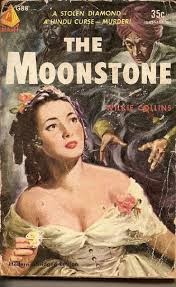
The Moonstone (1868) by Wilkie Collins, published on the London magazine All the Year Round directed by C. Dickens, was seen by the poet and critic T. S. Eliot as the first real detective story in literature. It deals with the theft of a notorious diamond, the Moonstone, occurred during the eighteenth birthday party of Rachel Verinder - the jewel is a gift to Rachel by his uncle, an unscrupulous officer of the British Army in India. 

DOWNLOAD diCARTA ebook FROM HERE


A cover of W. Collin's
The Moonstone 

The diamond has a great religious meaning and is searched by three Hindus who have devoted their lives to recover the it. To solve the intricate case is Sergeant Cuff, a solitary detective in retirement with a passion for roses. Sergent Cuff was one of the first investigators inspired by the real detective involved in the horrible murder of Road Hill House, Mr. Jonathan Whicher.

DOWNLOAD diCARTA ebook FROM HERE


The Moonstone mixes important historical events with mystery. The action takes place in the years 1848-49, at the time of the second Anglo-Sikh War in India, which established British control over that country and marked the beginning of "the empire" of the East India Company. The great diamond refers to two very famous stones: the Russian "Orloff" (the diamond in the Russian Imperial Sceptre) and the "Koh-i-Noor" (the Persian "mountain of light"), both stolen by Europeans. 


Copertina di
La Pietra di Luna
di W Collins 
 
T. S. Eliot definì primo vero romanzo poliziesco della letteratura inglese The Moonstone, La Pietra di Luna (1868) di Wilkie Collins (1824 – 1889) che uscì in Inghilterra nel 1868 a puntate sul periodico di Londra All the Year Round il cui direttore era Charles Dickens. 
Subito dopo una festa di compleanno, un gioiello viene rubato; si tratta di un gioiello molto prezioso la cui sparizione mette a nudo la vita di un uomo onesto e insospettabile, rivela l’ipocrisia di certe regole sociali e l’arroganza della civiltà occidentale che basa i suoi valori sul materiale e il commerciabile.


DOWNLOAD diCARTA ebook FROM HERE


Victorian interior 

La pietra di luna, così importante per i rabbini per la loro religione, diventa simbolo di potere e ricchezza in occidente, dove il suo valore prende un’importanza di tipo puramente economico. Il giallo diventa quindi un modo per avvicinare o contrapporre culture diverse, per sottolineare le disparità sociali ed evidenziare idiosincrasie e manie nascoste. Inoltre il personaggio dell'investigatore chiamato a risolvere si ispira al vero ufficiale di polizia Mr. Jonathan Whicher che si era occupato dell'orribile omicidio di Road Hill House, un uomo schivo e solitario, amante dei fiori.

Saturday, 20 December 2014

laNOTTE- Road House's secrets

Per la Versione Italiana

Road Hill House

An inspiration while writing diCARTA was the story of a terrible murder occurred in England in June 1860.  Three-year-old Saville Kent is found at the bottom of an outdoor privy with his throat cut. England is terrified and everyone tries to solve the mystery. 


Go to our Catalogue for Ebooks and Stories

The cover of the novel


To investigate the crime is called the greatest detective in the country, Inspector Jonathan Whicher. According to him, the guilty party is Constance, the plain, gloomy, teenage half-sister of little Saville Kent. And he is right, but the public opinion uproars in bewilderment and destroys the career of the detective. Five years later the girl confesses her crime, becoming one of the best-known names in England. As to Inspector Jonathan Whicher, heis still living on in fiction, as his figure has been an example for the all-knowing and all-seeing detectives nature loving such as Wilkie Collins’s Sgt. Cuff in The Moonstone, Sir Arthur Conan Doyle’s Sherlock Holmes, Agatha Christie’s Hercule Poirot, Dashiell Hammett’s Sam Spade and Rex Stout’s Nero Wolf.

Go to our Catalogue for Ebooks and Stories

The Suspicions of Mr. Whicher reads like the best of Victorian thrillers; Kate Summerscale has revived the mystery of Road Hill House depicting not only a crime, but the atmosphere of the period, the curiosity and the involvement of the English people, the attraction for what is criminal and macabre and the middle class society beyond the elegant and respectable façade - scheming servants, rebellious children, insanity jealousy, and hatred.  


Versione Italiana

The Murderer
Constance Kent 
Una delle influenze durante la creazione di diCARTA è stato il libro 
Omicidio a Road Hill House. Un delitto avvenuto nell’estate 1860 scuote l’opinione pubblica: Saville Kent, di tre anni, viene rapito e subito dopo trovato con la gola tagliata vicino alla sua abitazione. Tutti gli abitanti della elegante casa di Road Hill House in Wiltshire sono interrogati e dall’inchiesta emergono i particolari di una famiglia in apparenza inattaccabile: figli ribelli, tresche clandestine, solitudine, pazzia, gelosia e servitù intrigante. Il mistero s’infittisce e viene chiamato un detective di Londra, un giovane promettente, Jonathan Whicher, che già si era fatto notare in precedenza per il suo acume. 

Go to our Catalogue for Ebooks and Stories


Book cover

Il libro Omicidio a Road Hill House di Kate Summerscale (2008) mette in luce proprio come questo semplice poliziotto amante della campagna, solitario e timido rimarrà nella memoria collettiva ispirando molti dei famosi detective delle letteratura gialla e del mistero a partire dal sergente Cuff descritto da Wilkie Collins in La Pietra di Luna, all’immortale Sherlock Holmes create da Sir Arthur Conan Doyle e poi Hercule Poirot di Agatha Christie, Nero Wolf di Rex Stout o Sam Spade di Dashiel Hammet. Da questa letteratura nasce la passione per il noir e l'e-book diCarta.  


www.ilmiolibro.kataweb.itwww.women.it