Showing posts with label gialli. Show all posts

Sunday, 16 August 2015

visita - Margherita Oggero: detective stories in Turin


Margherita Oggero

Margherita Oggero was born in 1940. She is very popular for her detective stories set in Turin and featuring Camilla Baudino, a teacher of Italian literature who has a passion for crime and investigation. The first book of the series was La collega Tatuata, (The Tattooed Colleague) published in 2002 followed by Una piccola bestia ferita L'amica americana,  Così parlò il nano da giardino and Un colpo all'altezza del cuore. The novels have been adapted for the TV series Provaci ancora prof  (Try again,  teacher) starring  Veronica Pivetti. Other works include Qualcosa da tenere per sé,  Orgoglio di classe. Piccolo manuale di autostima per la scuola italiana e chi la frequenta, Il rosso attira lo sguardo.  Quattro stagioni di relazioni pericolose, Torino, l'ora blu,   Risveglio a Parigi and La ragazza di fronte. 
In 2011 she published her first detective story for children L'amico di Mizù - Mizù’s friend.


http://blog.librimondadori.it/blogs/segretissimo/tag/margherita-oggero/

http://lalettricerampante.blogspot.it/2015/06/incontrando-margherita-oggero.html


Margherita Oggero è una scrittrice di Torino, classe 1940, famosa per le storie gialle ambientate nella sua città natale. La protagonista è Camilla Baudino, insegnante di lettere italiane con una passione per il crimine e le indagini. Il primo libro delle serie è stato La collega Tatuata seguito da Una piccola bestia ferita L'amica americana,  Così parlò il nano da giardino e Un colpo all'altezza del cuore. I romanzi sono stati adattati per la televisione nelle serie Provaci ancora Prof, interpretata da Veronica Pivetti. 
Altri testi della stessa autrice sono Qualcosa da tenere per sé,  Orgoglio di classe. Piccolo manuale di autostima per la scuola italiana e chi la frequenta, Il rosso attira lo sguardo.  Quattro stagioni di relazioni pericolose, Torino, l'ora blu,   Risveglio a Parigi e La ragazza di fronte. Nel 2011 è uscito il suo primo giallo per bambini, L'Amico di Mizù. 


Thursday, 30 July 2015

Visita - Cesare Pavese

Cesare Pavese
Cesare Pavese,  Italian poet and writer,  was born on 9 September 1908. Educated in Turin, he soon showed a great interest in English-language literature. He  graduated from the University of Turin with an essay on  Walt Whitman' s poetry and translated both classic and recent English speaking authors almost unknown to the Italian readers.  As he  moved in antifascist circles, Pavese  was arrested, convicted and  then sent into "internal exile " in Southern Italy, like Carlo Levi and Leone Ginzburg. Back in Turin after a year, he worked for publisher Giulio Einaudi and was mentor of young writer Fernanda Pivano, his former student at the Liceo D'Azeglio. She  translated the American edition of Edgar Lee Masters' Spoon River Anthology that Pavese had given her. When German troops occupied Turin he escaped  to the hills near Casale Monferrato, but  he never took part in  the armed struggle.  After the war,  Pavese joined the Italian Communist Party and worked for “L'Unità”. Depression, the failure of a brief love affair and political disillusionment led him to his suicide by an overdose of barbiturates  in a hotel room of Piazza Carlo Felice in Turin on 27th August 1950. In the same year he had won the Strega Prize for La Bella Estate.


Go to our Catalogue for Ebooks and Stories


Cesare Pavese 
Cesare Pavese, scrittore, poeta e critico Italiano nacque il 9 settembre a santo Stefano Belbo vicino a Cuneo. Compì i suoi studi a Torino e, appassionato di letteratura inglese e americana, si laureò con una tesi sulla poesia di Walt Whitman. Suo mentore all'università fu leone Ginzburg, critico ed esperto di letteratura russa, marito della famosa scrittrice  Natalia e padre dello storico Carlo. Antifascista, fu arrestato, imprigionato e quindi mandato in esilio in sud Italia. Al suo ritorno, dopo una anno, lavorò come editorialista presso la casa editrice  Einaudi e fu mentore della scrittrice e traduttrice Fernanda Pivano – traduttrice de  l' antologia di Spoon River di Edgar Lee Master donatale dallo stesso  Pavese. Durante la guerra,  Pavese si rifugiò sulle colline del Monferrsto,  ma non prese mai parte alla guerra partigiana; dopo la guerra si unì al partito comunista e scrisse per L'Unità. Una forte depressione causata da delusioni politiche e private lo portò al suicidio: inghiottì una forte dose di barbiturici  in una camera d'albergo in Piazza Carlo Felice a Torino,  il 27 agosto 1950 – nello stesso anno in cui vinse il Premio strega per  La Bella Estate.


Go to our Catalogue for Ebooks and Stories


Sunday, 8 February 2015

Visita- Nostradamus a Torino?

Per la Versione Italiana

Nostradamus


Maybe it is not well know that Nostradamus spent a period in Turin in 1556. He was probably called by Emanuele Filiberto from Savoy to help his wife have a baby. Nostadamus was said to be able to prepare a miraculous oil to cure sterility. He stayed in a fine villa outside the city, La Vittoria, later named Il Morozzo,  where  a commemorative stone was then found with the words: 

1556/ Nostradamus lived here, where there is Paradise, Hell and Purgatory. My name is Victoria; who gives me honour, will get glory, who blames me, will be ruined 


Nostradamus predicted the birth of the Duke’s heir but also the date of his death “when 9 will be before a 7”: Carlo Emanuele died just before his 70th birthday. But mystics state that Nostradmus came to Turin attracted by the famous alchemic caves. Besides, as stories go, in 1556 there was a great meeting of  the Priory of Sion, and Michael Nostradamus was its Great Monarch. 


Michael Nostradamus and his prophecies

Forse non tutti sanno che Nostradamus fu ospite di Torino, nel 1556! Era stato chiamato da Emanuele Filiberto di Savoia per aiutare la moglie Margherita di Valois ad avere un figlio. 


Nostradamus aveva infatti la fama di preparare un olio miracoloso in grado di combattere la sterilità e, a tale scopo, venne ospitato con discrezione nella villa La Vittoria denominata in seguito Il Morozzo dove è stata trovata una lapida con su incise le parole I556

    Nostre Damus a loge ici
     On il ha le paradis lenfer
     Le purgatoire ie ma pelle
      La victoire qvi mhonore
     Avrala gloire qvi me
    Meprise ovra la 
    Rvine hntiere

1556 / Nostradamus alloggiò qui dov'è il Paradiso, l'Inferno, il Purgatorio, io mi chiamo la Vittoria; chi mi onora avrà la gloria, chi mi disprezza avrà la completa rovina".

Nostradamus predisse al Duca la nascita dell'erede e ne specificò anche il nome, Carlo Emanuele. Disse anche che sarebbe morto "quando un nove si troverà davanti a un sette": Carlo Emanuele morì infatti a 69 anni, prima di compierne 70, e la profezia si avverò.Gli esoteristi sostengono, invece, che a muovere i suoi interessi fossero piuttosto le misteriose grotte alchemiche torinesi. Inoltre si ritiene che proprio a Torino ci fosse stata nel 1556 una riunione del Priorato di Sion di cui Michael de Nostradamus era il Gran Maestro

Wednesday, 4 February 2015

laNOTTE- Diabolik in Turin


Per la Versione Italiana


Diabolik's eyes


What people really do not know is that Turin has a negative record - it is the city with the largest number of unsolved women's murders.
And  it is Turin itself the place where the story of Diabolik was born: a man murdered a young worker and challenged the police naming himself Diabolich (without K).


Go to our Catalogue for Ebooks and Stories


It was Tuesday, February 25th, 1958, and the victim was a Fiat worker aged twenty seven, Mario Giliberti. he was found bloodless in the back of a shoemaker's shop at 20, Via Fontanesi. The weapon and the murderer were never found. There was a note on a wardrobe knocker: "You'll find the killer...".
The young man came from the South of Italy, she was engaged with a girl from Lodi where he had done his military service. In his poor room there was a lot of money, probably coming from a robbery or a usurer. The murderer provoked the police first with an anonimous call, then with a letter revealing the motive of the criminal action: revenge. But not much more.  

Go to our Catalogue for Ebooks and Stories

People started their chase and the investigations led to a comrade in arms of Giliberti - but the clues were not enough and he was soon set free.
In the  novel inspired by the case, 
Uccidevano di notte, by Italo Fasan, Diabolic (without h or k) was a poor actor, who, at the end of his life, had decided to take the law into his own hands. Only after four years the name of Diabolik appeared on the comic stip written and published by two wealthy sisters from Milan, Angela and Luciana Giussani - the creators of the diabolic robber.  


Versione Italiana
 
Diabolik and Eva 


Sapete che Torino vanta anche un record di cui farebbe volentieri a meno? E’ la città con il maggior numero di omicidi insoluti di donne.
Non solo, chi direbbe che proprio Diabolik – o almeno l’idea del personaggio – è nato qui? Sì, un Diabolik in carne ed ossa uccise un giovane a Torino e poi sfidò la polizia con una serie di lettere con la firma appunto di «Diabolich» (senza K, ma con ch). 

L’omicidio avvenne il 25 febbraio 1958, un martedì e la vittima era un operaio Fiat di 27 anni, Mario Giliberti, che fu ritrovato morto dissanguato, dopo essere stato colpito 11 volte e poi avvolto in un lenzuolo, sul pavimento della sua camera da letto al pianterreno, nel retro di un calzolaio in via Fontanesi 20, quartiere Vanchiglia. L’arma del delitto non fu mai ritrovata e nemmeno l’assassino, nonostante un indizio: sul pomello di un armadio c’era un biglietto lasciato a metà: «Troverete l’assas ...». Era morto da almeno dieci giorni quel giovane di origini meridionali, con una fidanzata a Lodi, dove era stato da militare. Gli inquirenti trovarono dei soldi, forse frutto di una rapina o presi da un usuraio. Sta di fatto che l’assassino, vedendo che nessuno si accorgeva del suo operato, telefonò lui stesso a La Stampa, annunciando di aver ucciso un uomo sulla via di Po. Ancora nulla … Allora inviò una lettera che, con un linguaggio da enigmista dilettante, rivelava l' indirizzo esatto e il movente: «Un tempo eravamo molto amici e portavamo la divisa comune, poi lui mi tradì come un cane. Adesso sta bene così che la mia vendetta, l’ha raggiunto. Spero che scopriate il cadavere prima che diventi marcio». 

Go to our Catalogue for Ebooks and Stories

Anche allora l’opinione pubblica si scatenò in una caccia all’assassino, e non solo in Italia. Per la verità né il delitto né le modalità erano originali: l’omicida si era ispirato a un romanzo giallo uscito circa un anno prima, Uccidevano di notte, di Italo Fasan, dove «Diabolic», senza l' acca, era un attore malato con pochi mesi di vita che aveva scelto di farsi giustizia da solo. Le indagini che seguirono portarono all’arresto di Aldo Cugini, un commilitone di Giliberti, bergamasco, ma gli indizi non riuscirono a portare una condanna. Però il delitto ispirò quattro anni dopo Angela e Luciana Giussani, ragazze bene di Milano, che crearono Diabolik, un fumetto tascabile comodo da leggere in treno per i pendolari. Le sorelle non confermarono né negarono mai l’ispirazione torinese del loro fumetto alimentando il mistero.
ricerca.repubblica.it › la Repubblica.it › 2008 › 02 › 
www.torinonightlife.com/.../l-enigmista-di-via-fontanesi-che-ispiro-il-fu...

Monday, 12 January 2015

atNIGHT- Who created the Detective Story?


Per la Versione Italiana


Cover of the novel
The Notting Hill Mystery

The Gothic novel started the mystery genre, but who was the first detective story writer? Most critics state that he was Edgar Allan Poe whose fertile imagination created inspector August Dupin. T. S. Eliot, poet and critic, supports that the first was instead Wilkie Collins, Charles Dickens' close friend and author of The Moonstone.

As a matter of fact, a test which dealt with mystery and detection had already appeared in installments on the magazine Once a Week (Edited by C. Dickens) on December 27, 1862, The Notting Hill Mystery. The author was unknown as the novel was written under pseudonymous. It was supposed to be Charles Warren Adams (1833-1903), a lawyer, author of mysterious stories.
Illustration of the Novel
 on the magazine once a Week 

The Notting Hill Mystery is about the adventures of an insurance agent, Ralph Henderson, who must investigate on Baron R suspected of his wife's murder. She died after drinking an acid taken from his husband's laboratory. The Baron is surely involved, but he evidences are not found. While investigating, the agent discovers other murders, all of them seem to have the Baron's mark. The truth will be unveiled thanks to letters, sheets of diaries, maps of the murder scene: techniques now quite familiar, but very unusual for the Victorian readers. The novel, forgotten for a long period, had now been published again on its 150th anniversary. 


La rivista
 Once a Week 

Il Gotico ha aperto la via al tema del mistero....ma qual è stato il primo vero giallo cronologicamente parlando? In molti pensano che il primo detective della storia sia stato Monsieur Dupin creato da Edgar Allan Poe. Secondo il poeta e critico T. S. Eliot il primo vero giallo fu varato da Wilkie Collins con La Pietra Di Luna.


Ma un misterioso testo era già stato pubblicato The Notting Hill Mystery che apparve per la prima volta a puntate sulle pagine della rivista Once A Week (Una Volta alla settimana, pubblicazione curata da C. Dickens) il 27 dicembre 1862, illustrato da George du Maurier, nonno della poi famosa scrittrice del mistero Daphne Du Maurier. L’autore rimase pressoché sconosciuto per molti anni in quanto la firma Charles Felix era uno pseudonimo. Nel 1952 William Buckler suggerì che poteva essere Charles Warren Adams (1833-1903), un avvocato già autore di altre storie del mistero, ipotesi confermata da studiosi e critici.

Go to our Catalogue for Ebooks and Stories

Illustrazione del romanzo sulla rivista
Once a Week

Comunque The Notting Hill Mystery (Il mistero di Notting Hill), ora considerato il capostipite dei gialli, racconta le avventure dell’agente investigativo delle assicurazioni Ralph Henderson nel caso contro il Barone "R___", sospettato dell'omicidio della moglie. La donna sembrava avesse bevuto casualmente una bottiglia di acido nel laboratorio del marito durante uno dei suoi giri notturni da sonnambula. Il marito viene sospettato perché ha stipulato ben cinque assicurazioni sulla vita della moglie. Mentre investiga, Henderson scopre altri tre omicidi …. La colpevolezza del barone è evidente, ma sembra impossibile trovare le prove. La verità sarà scoperta attraverso lettere e diari, deposizioni, rapporti di chimica, mappe sulla scena del delitto: tecniche ora comuni, ma all’epoca davvero innovative. Per molto tempo il testo è stato, dimenticato, solo per il suo 150° anniversario è stato ripubblicato con le stesse immagini apparse nella sua forma originale del 1863.

Monday, 29 December 2014

atNIGHT- a dangerous diamond

Per la Versione Italiana


The Great Exhibition (1851)


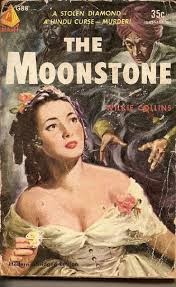
The Moonstone (1868) by Wilkie Collins, published on the London magazine All the Year Round directed by C. Dickens, was seen by the poet and critic T. S. Eliot as the first real detective story in literature. It deals with the theft of a notorious diamond, the Moonstone, occurred during the eighteenth birthday party of Rachel Verinder - the jewel is a gift to Rachel by his uncle, an unscrupulous officer of the British Army in India. 

DOWNLOAD diCARTA ebook FROM HERE


A cover of W. Collin's
The Moonstone 

The diamond has a great religious meaning and is searched by three Hindus who have devoted their lives to recover the it. To solve the intricate case is Sergeant Cuff, a solitary detective in retirement with a passion for roses. Sergent Cuff was one of the first investigators inspired by the real detective involved in the horrible murder of Road Hill House, Mr. Jonathan Whicher.

DOWNLOAD diCARTA ebook FROM HERE


The Moonstone mixes important historical events with mystery. The action takes place in the years 1848-49, at the time of the second Anglo-Sikh War in India, which established British control over that country and marked the beginning of "the empire" of the East India Company. The great diamond refers to two very famous stones: the Russian "Orloff" (the diamond in the Russian Imperial Sceptre) and the "Koh-i-Noor" (the Persian "mountain of light"), both stolen by Europeans. 


Copertina di
La Pietra di Luna
di W Collins 
 
T. S. Eliot definì primo vero romanzo poliziesco della letteratura inglese The Moonstone, La Pietra di Luna (1868) di Wilkie Collins (1824 – 1889) che uscì in Inghilterra nel 1868 a puntate sul periodico di Londra All the Year Round il cui direttore era Charles Dickens. 
Subito dopo una festa di compleanno, un gioiello viene rubato; si tratta di un gioiello molto prezioso la cui sparizione mette a nudo la vita di un uomo onesto e insospettabile, rivela l’ipocrisia di certe regole sociali e l’arroganza della civiltà occidentale che basa i suoi valori sul materiale e il commerciabile.


DOWNLOAD diCARTA ebook FROM HERE


Victorian interior 

La pietra di luna, così importante per i rabbini per la loro religione, diventa simbolo di potere e ricchezza in occidente, dove il suo valore prende un’importanza di tipo puramente economico. Il giallo diventa quindi un modo per avvicinare o contrapporre culture diverse, per sottolineare le disparità sociali ed evidenziare idiosincrasie e manie nascoste. Inoltre il personaggio dell'investigatore chiamato a risolvere si ispira al vero ufficiale di polizia Mr. Jonathan Whicher che si era occupato dell'orribile omicidio di Road Hill House, un uomo schivo e solitario, amante dei fiori.

Sunday, 7 December 2014

Di cosa è fatto diCARTA? oltre le pagine


diCARTA nasce dalla passione per i gialli e per l’occulto, ma anche un campanilistico amore per Torino, Torino barocca, Torino liberty, Torino la misteriosa …


diCARTA è un ebook, ovvero un libro digitale; è il primo libro che pubblichiamo con NOTTEpress ed è una storia che dimostra come, nonostante questa attrazione per la tecnologia, la magia, il mistero, l’inspiegabile esercitano ancora .una forte attrazione. Una trama che collega Torino agli altri poli del triangolo magico; che si sta prendendo forma giorno dopo giorno tra scambi epistolari e voicechat.

Se non hai ancora letto il trailer diCARTA lo trovi di seguito,

SCARICA diCARTA ebook DA QUI

Trailer:
Un incidente stradale, una gamba rotta e un sogno messicano infranto.
La scoperta di parole impolverate e simboli misteriosi,
sogni e realtà per un intrigo di misteri dal passato.

SCARICA diCARTA ebook DA QUI